Coloring
Dinosaur Coloring Pages: 10 Prehistoric Animals, One Fact Each
Ten free dinosaur coloring pages for kids: T. rex, Triceratops, Stegosaurus, a long neck, a raptor, Ankylosaurus, Allosaurus, a baby dinosaur and more.
Our sheets are free. The clipart shown alongside them is sold on Creative Fabrica; those links are affiliate links; a sale may pay the gallery a commission.

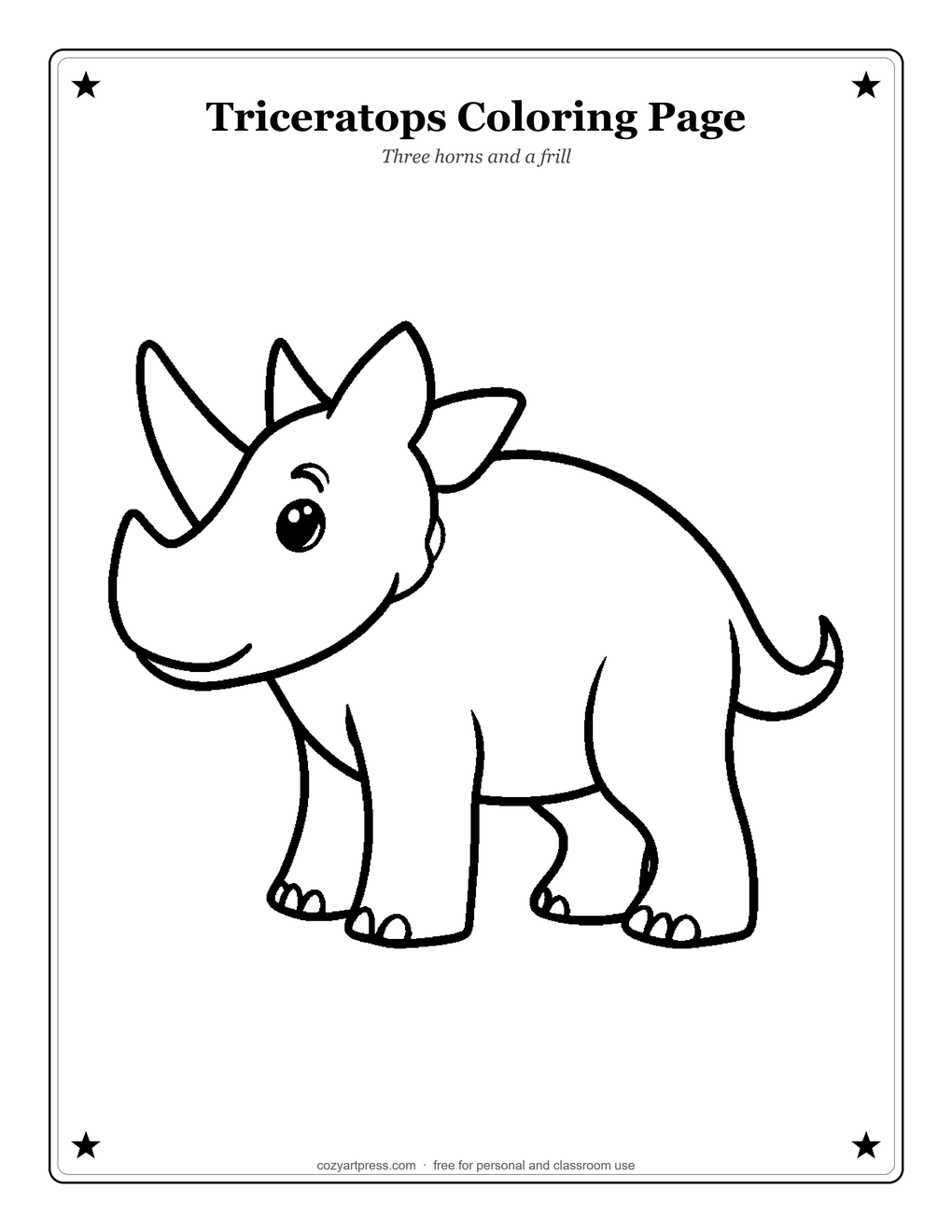

These 10 dinosaur coloring pages put a real animal from the fossil record on every sheet: T. rex, Triceratops, Stegosaurus, a long-necked plant-eater at a tree, a flying reptile, a hatchling breaking out of its egg, a raptor, Ankylosaurus, Allosaurus and a parent with its young. The outlines are thick and the faces friendly, so even a three-year-old can stay roughly inside the lines. Below each name you will find one fact to read aloud while the crayons move.
Grab any page as its own PDF, or the single file with all ten. They print in black ink on letter-size paper and may be copied for home or a classroom.
Free PDF · 10 pages · US Letter
The sheets
Click a sheet to open its PDF. Print at 100% scale (or fit to page on A4).
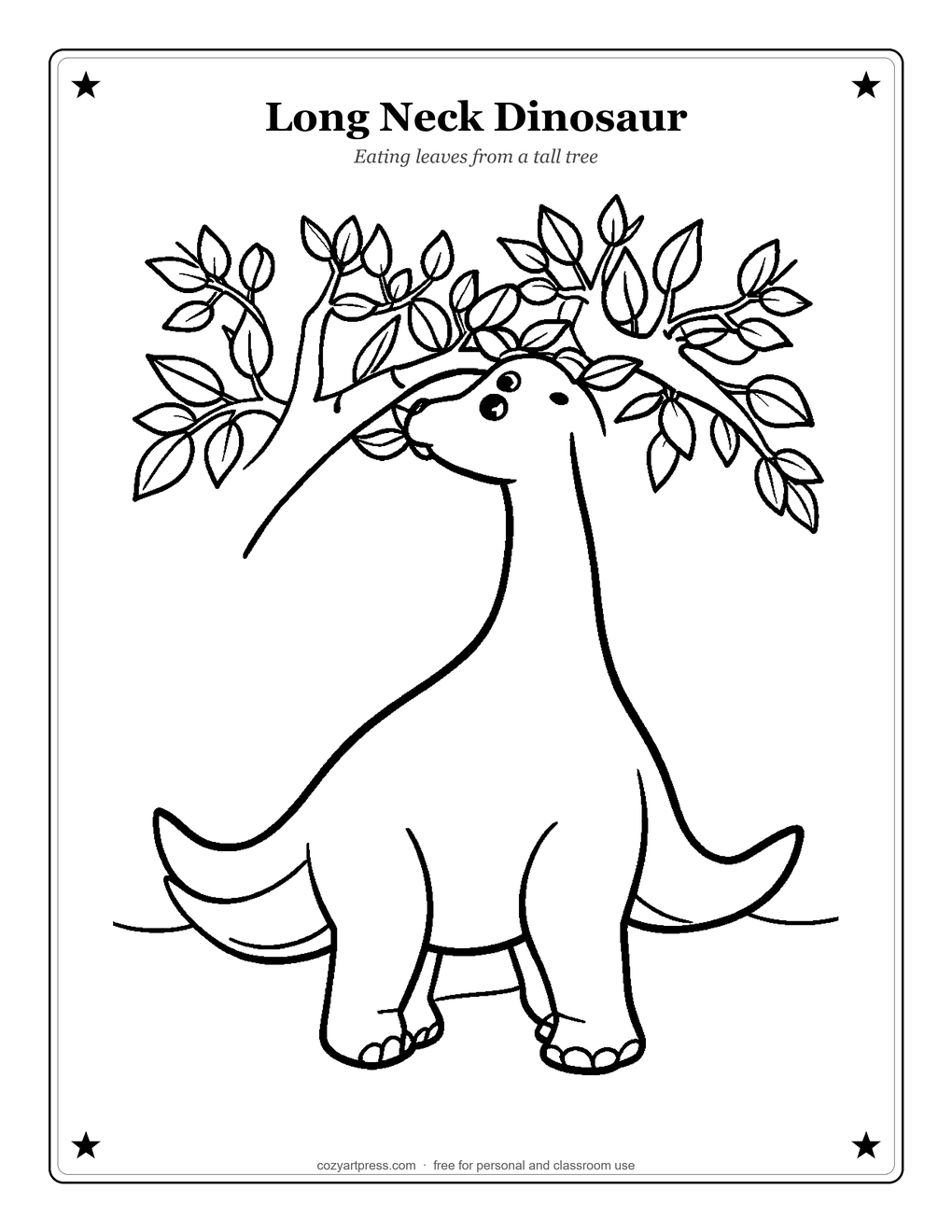


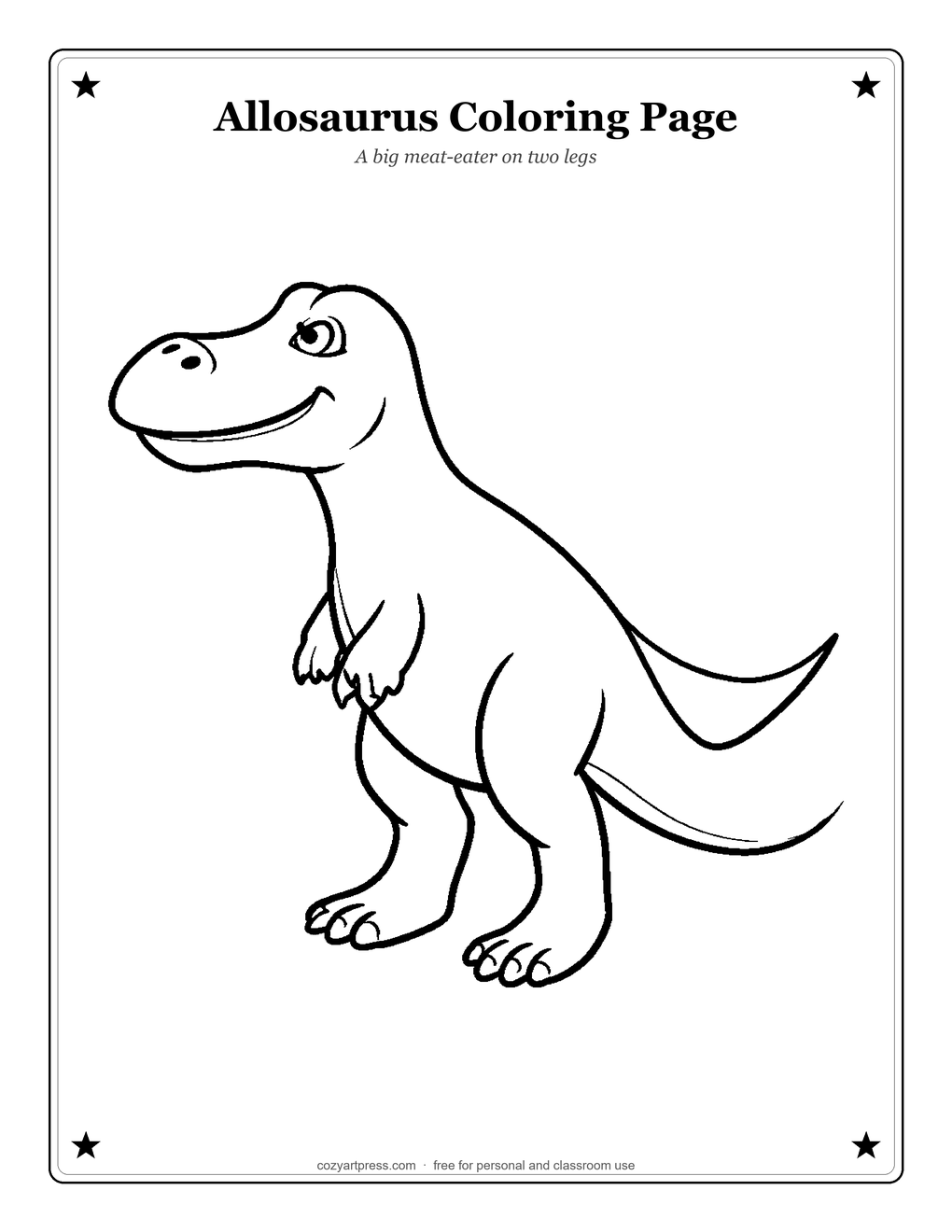

Download the whole set as one PDF — 10-page PDF.
01 —Easiest Page to Hardest
| Page | What the child colors | Try it from |
|---|---|---|
| Baby dinosaur | A hatchling peeking out of a cracked egg | Age 2 or 3 |
| Triceratops | One big body in simple shapes | Preschool |
| Stegosaurus | A row of plates along the back | Preschool |
| T. rex | Teeth and claws | Age 4 |
| Long neck dinosaur | A dinosaur reaching into a tree | Age 4 |
| Flying reptile | Wings among the clouds | Age 4 |
| Raptor | A small, quick hunter | Age 5 |
| Ankylosaurus | Bumpy armor | Age 5 |
| Allosaurus | A big two-legged meat-eater | Age 5 |
| Dinosaur family | Two dinosaurs in a landscape | Age 5 |
02 —One Fact for Each Dinosaur
A short fact read aloud while the crayons are out is the easiest science lesson there is.
- Tyrannosaurus rex was a meat-eater with a huge head and very short arms. It grew to about 40 feet (12 m) long and lived 68 to 66 million years ago, among the last dinosaurs.
- Triceratops ate plants. Its name means "three-horned face", and it was about 30 feet (9 m) long.
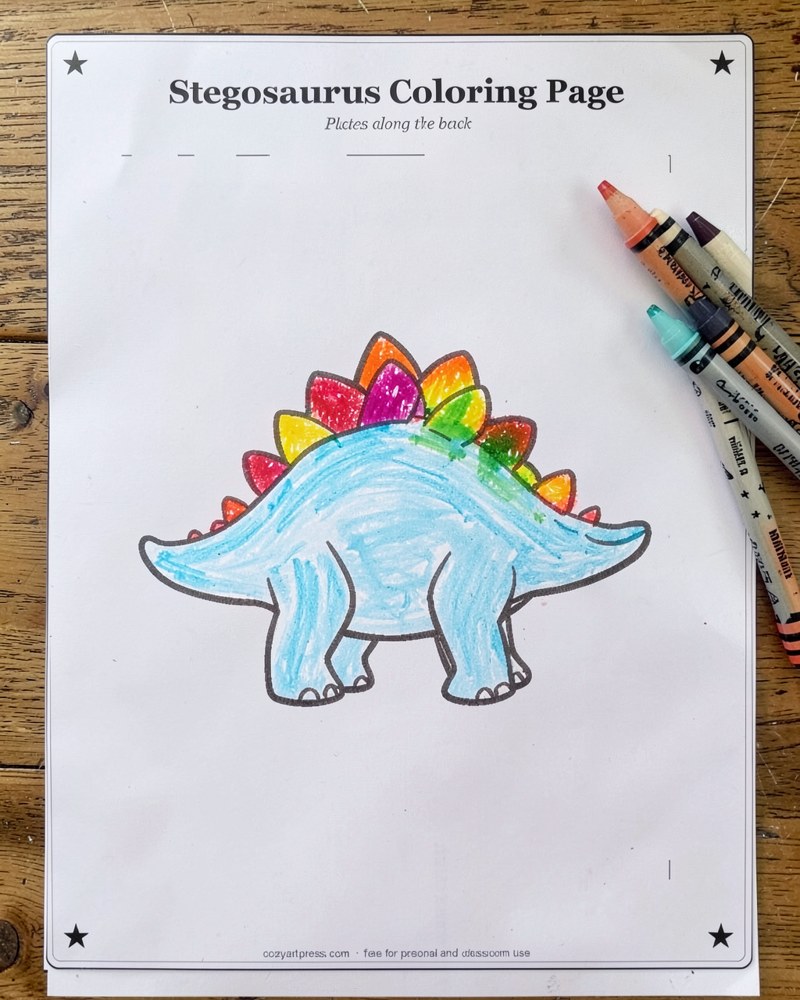
- Stegosaurus had two rows of bony plates along its back and spikes at the end of its tail. Nobody knows for sure what the plates were for.
- Long-necked dinosaurs such as Brachiosaurus could reach leaves at the tops of tall trees.
- Flying reptiles such as pterosaurs lived at the same time as dinosaurs, from about 220 to 66 million years ago, but they were not dinosaurs themselves.
- Velociraptor was much smaller than in the films: about 6 feet (1.8 m) long, most of it tail, and roughly the size of a turkey. Bumps on a fossil forearm where wing feathers were anchored show that it had feathers. The raptor on our page has none, so let the child draw them on.
- Ankylosaurus was covered in bony armor and had a heavy club at the end of its tail, which it swung from side to side against predators.
- Allosaurus was a large meat-eater, about 32 feet (9.7 m) long, that lived 152 to 145 million years ago. That is roughly 80 million years before T. rex, so the two never met.
Children who love dinosaurs often know more than the adults. Ask them to add a fact of their own to each page.
03 —What Color Was a Dinosaur?
For most dinosaurs, nobody knows. Color has been worked out only for a handful of species whose feathers or skin were preserved, such as the small feathered Anchiornis and Sinosauropteryx and the armored Borealopelta. Stegosaurus, T. rex and the long necks are not among them, so a purple Stegosaurus is as good a guess as a green one.
That makes these pages a rare case where no crayon is wrong, as long as the child can give a reason. Living animals offer plenty of reasons to borrow:
- Hide in the ferns. Greens and browns broken up with stripes or blotches, the way many lizards and frogs blend into leaves.
- Dark on top, pale beneath. Borealopelta seems to have had this pattern, called countershading, which flattens an animal's shape in sunlight.
- Show off. A red frill on the Triceratops or bright plates on the Stegosaurus, the way male birds use color to signal.
- Pure invention. A different color for every plate. Science cannot prove it wrong.
Then ask the child why they chose it. "So it can hide in the leaves" is a real scientific idea.
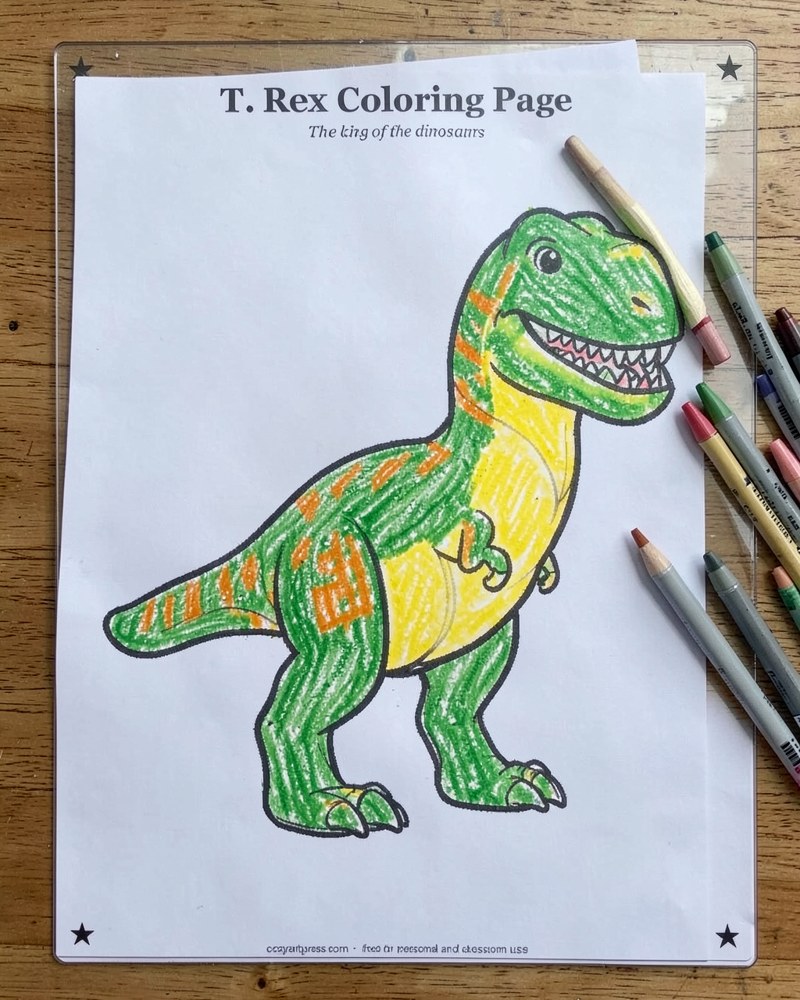
Both pictures above are digital mock-ups colored on our own pages to give you ideas; no child colored them.
04 —Add a Background
Most pages show the dinosaur on its own, with white space around it. That space is an invitation.
Draw the ground first, then something to eat: ferns and tall trees for the plant-eaters. Add a volcano in the distance, a river, a nest of eggs behind the mother, a sun or a moon.
A simple rule keeps it going: three things in the sky, three on the ground.
05 —Projects for Finished Dinosaurs
- A field guide. Bind all ten colored pages with a cover, and under each dinosaur write its name, what it ate and its length from the facts above.
- A timeline on the wall. Tape the pages along a hallway in the order the animals lived, with Allosaurus far from T. rex; the empty gap between them says more than any number.
- A shoebox dig site. Cut out the colored animals, stand them on folded card tabs and set them in a box painted with ferns and a river.
- Stick puppets. Tape a cut-out dinosaur to a straw and act out a hatchling meeting its parent.
- Big words. Ankylosaurus has eleven letters; write it in large letters under the picture and clap out the syllables.
- A party table. At a dinosaur birthday, a pile of pages and a cup of crayons gives early arrivals something to do.
06 —Sorting the Dinosaurs
Ten pages are enough for a sorting game on the floor.
- Plant-eaters and meat-eaters. T. rex, the raptor and the Allosaurus on one side; Triceratops, Stegosaurus, the long neck and Ankylosaurus on the other.
- Two legs or four.
- Armor, horns, plates or none.
- Dinosaur or not. The flying reptile goes in a pile of its own.
In a classroom, this turns a coloring session into the start of a science unit.
07 —Paper and Crayons
The pages are drawn for US Letter. If your printer holds A4, let it shrink the page slightly to fit; nothing important sits near the edge. Everyday printer paper takes crayons and colored pencils well. Heavier paper is worth it for markers that soak through, for paint, and for any dinosaur that will be cut out and stood on a tab.

Crayons cover the big bodies quickly. Colored pencils are better for teeth, claws and spots.
08 —From Fossils to Living Animals
Paleontologists guess at dinosaur skin by looking at living animals, and children can do the same: a full-color picture of an elephant, a zebra or a crocodile is a fine model for wrinkles, stripes and scales. The three sets below are from the safari and jungle animal clipart shelf, drawn by independent designers.
When the coloring is done, test what everyone remembers with our animal trivia questions or the animal riddles. For a different kind of wings, see the butterfly coloring pages. The full list of free sheets lives on the printables page.

