Coloring
Butterfly Coloring Pages From Caterpillar to Mirror-Image Wings
Eight free butterfly coloring pages: a simple butterfly, patterned wings, a butterfly on a flower, three butterflies, a caterpillar, a garden and more.
Our sheets are free. The clipart shown alongside them is sold on Creative Fabrica; those links are affiliate links; a sale may pay the gallery a commission.


These 8 butterfly coloring pages follow an insect from leaf to flower: a caterpillar on its food plant, a simple butterfly with big wings, one with patterned wings, one sipping from a daisy, three in flight, a garden scene, a butterfly with hearts on its wings and a finely detailed one for older children. Along the way they teach the two things every young naturalist should know about butterflies: their wings are mirror images, and they start life as something else entirely.
Every outline can be downloaded alone, or all eight together in a single file. Print them on letter-size paper in plain black ink; copying them for your family or class is fine.
Free PDF · 8 pages · US Letter
The sheets
Click a sheet to open its PDF. Print at 100% scale (or fit to page on A4).


Download the whole set as one PDF — 8-page PDF.
01 —Matching Pages to Small Hands
| Page | What the child colors | Suits |
|---|---|---|
| Simple butterfly | Big wings, a few large spots | Toddlers |
| Heart wing butterfly | Two hearts, both on the right-hand wings | Preschoolers |
| Caterpillar on a leaf | One caterpillar, one leaf | Preschoolers |
| Butterfly on a flower | A butterfly and a daisy | Ages 4 and up |
| Three butterflies | Three small butterflies in flight | Ages 4 and up |
| Butterfly garden | Butterflies, flowers, grass | Ages 5 and up |
| Patterned butterfly | Wings in many sections | Ages 6 and up |
| Detailed butterfly | Ovals, circles and fine veins | Ages 8 and up |
02 —The Secret of Butterfly Wings: Symmetry
A butterfly's left wing is a mirror image of its right. That one idea makes these pages more than coloring.
Ask the child to color one wing first, then copy it on the other side: the same colors in the same places. For a five-year-old this is real work. It takes looking back and forth, counting sections and remembering an order.
Younger children can ignore the rule. Older ones can try the harder version: an adult colors the left wing in a pattern, and the child has to match it exactly on the right.
The heart wing page has a built-in puzzle: its two hearts are both on the right-hand wings. Ask the child to draw matching hearts on the left so the butterfly is symmetrical, then color it.

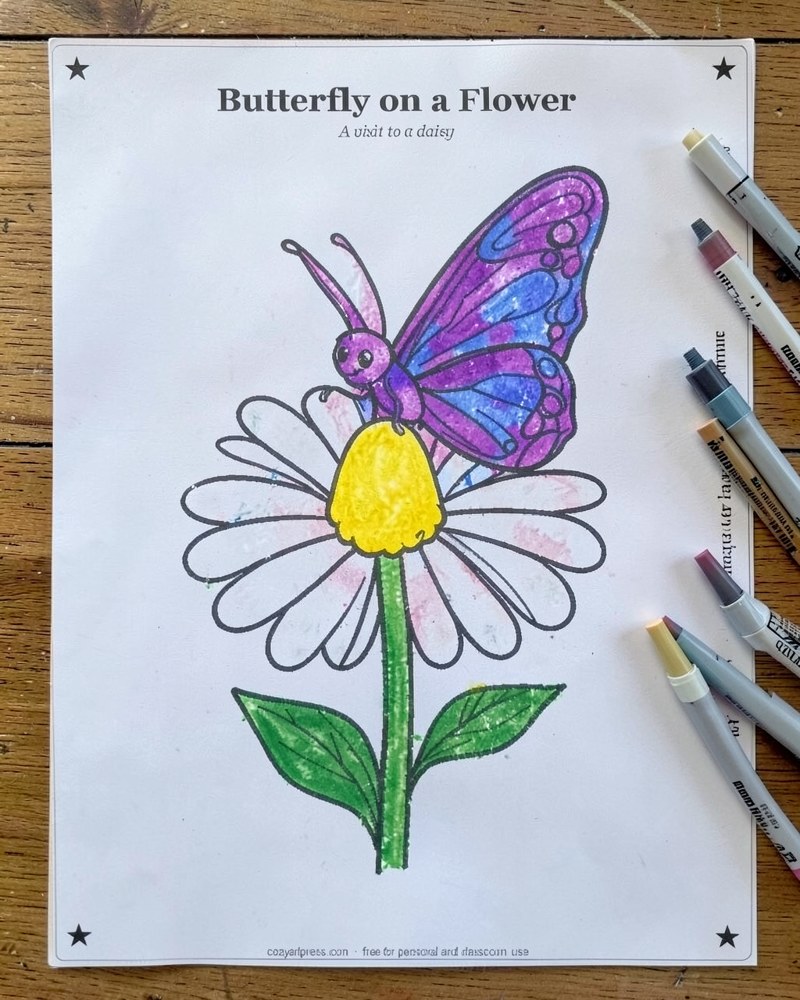
The two colored butterflies are sample renderings we made from the printable outlines, shown for ideas; they are not real children's artwork.
03 —Fold-and-Press Painting
The simple butterfly page is made for the classic symmetry craft.
- Print the page on cardstock and fold it in half down the middle of the butterfly's body. Open it again.
- Drop a few blobs of paint on one wing only.
- Fold the page shut and press gently from the fold outward.
- Open it. The pattern has printed itself onto the second wing.
Use two or three colors at most, and keep the blobs away from the edge. Let the page dry flat.
04 —Palettes From a Field Guide
Real wings are the best color chart. Pull up photos of two or three local species, let the child pick one, and copy it as closely as the outline allows.
- Monarch. Orange panels, black veins, and a black border with two rows of small white spots. The patterned page has enough sections to show it.
- One color family per butterfly. Do the first butterfly all in sunset shades and the next one all in pond shades, then ask which would be easier to spot on a green leaf.
- Spectrum from the body out. On the patterned page, start at the body with red and move outward through orange, yellow, green and blue to purple at the wing tips.
- Tiny patterns. Fill every section of the detailed page with dots, stripes or crosshatching using fine-tip markers.
- A sparkle edge. Once the color is dry, run glitter glue along the wing outlines.
05 —From Caterpillar to Butterfly
Two pages in the set belong together: the caterpillar on a leaf and any of the butterflies. Between them is one of the best stories in nature.
A butterfly begins as an egg on a leaf. A caterpillar hatches and eats, and eats, and grows. Then it forms a chrysalis, a hard case in which its body changes completely. At last a butterfly comes out, unfolds its wings and flies.
Color the caterpillar page first and a butterfly page second, and ask the child to tell the story in between. Children who can write can add the four words along the bottom of the page.
06 —Facts to Share While Coloring
- A butterfly has four wings, two on each side, and six legs. In brush-footed butterflies, the family that includes the monarch, the front pair is tiny and held against the body, so they seem to stand on four.
- The two feelers on its head are called antennae. A butterfly's end in a small club; most moths have thin or feathery antennae.
- Butterflies taste with their feet. When one lands on a leaf, it is finding out whether the leaf is right for its eggs.
- Butterflies drink through a long tube called a proboscis, like a straw, that curls up when it is not in use.
- Butterflies are active by day and usually rest with their wings folded up. Most moths fly at night.
07 —Butterflies Off the Page
- Sun catchers. Marker-colored wings glow when the paper is stuck to a sunny pane of glass.
- A hanging flight. The three butterflies, cut out and strung at different heights from a twig, turn slowly in a draft.
- Lifting wings. Glue a cut-out butterfly onto a folded card by its body alone, so both wings stand free of the paper.
- Migration wall. Each child in a class colors one butterfly, and the whole group travels up the wall in a long line, the way monarchs travel in fall.
- Garden tally. Clip the garden page to a board by the window and add a mark every time a live butterfly visits.
08 —Learning Goals for a Spring Unit
The set fits a unit on insects or life cycles. By the end, children should be able to name the four stages, show a line of symmetry and count an insect's legs.
- Art and math. Symmetry coloring, as described above.
- Sequencing. Order the caterpillar and butterfly pages and write a sentence for each stage.
- Observation. Compare the three butterflies: what is the same about them, and what is different?
- Quiet time. The detailed page keeps older children busy for a long while.
09 —Paper, Paint and Pencils
The outlines are set up for US Letter; an A4 printer only needs to scale them down a touch. Ordinary printer paper is enough for pencils and crayons. The fold-and-press painting and any butterfly headed for a window or a mobile need heavier stock, which stays flat when wet and holds up to scissors.

Colored pencils suit the small sections of the patterned wings. Washable paint is for the fold-and-press butterfly.
10 —Pollinators in Full Color
Full-color butterfly art is handy as a reference when children want to copy real wing patterns. These three sets sit on our bird, butterfly and bee clipart shelf, each by an independent designer.
Butterflies are insects, and insects are one of six groups in our animal classification sorting activity. For bigger animals, print the dinosaur coloring pages. The rest of the free sheets are waiting on the printables page.

