Coloring
Ocean Animals Coloring Pages for a Sea Mural, Surface to Sand
Eight free ocean animals coloring pages for kids: a whale, a jumping dolphin, a sea turtle, an octopus, a clownfish, a seahorse, a crab and a shark.
Our sheets are free. The clipart shown alongside them is sold on Creative Fabrica; those links are affiliate links; a sale may pay the gallery a commission.
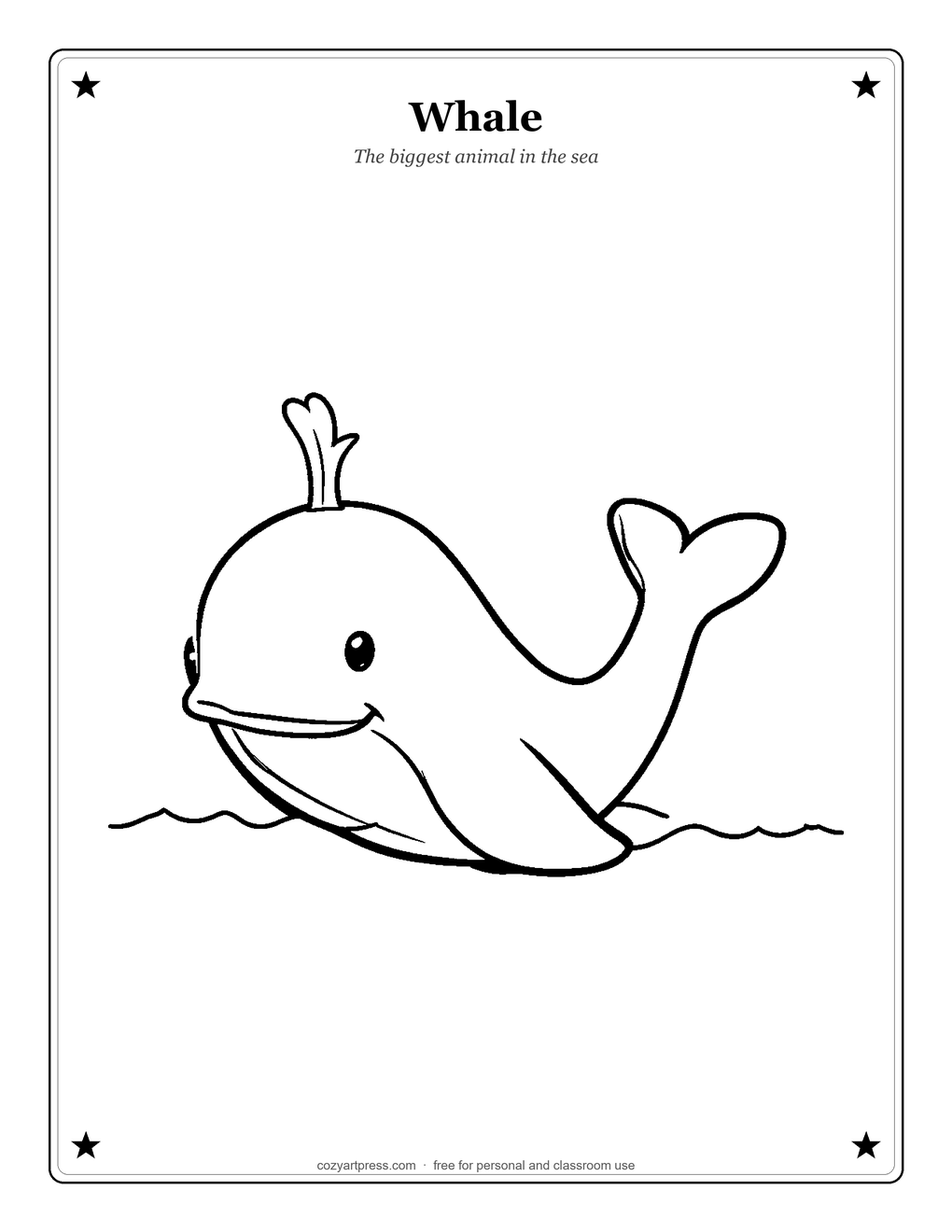


These 8 ocean animals coloring pages cover the sea from the surface to the sand: a whale blowing its spout, a dolphin leaping clear of the waves, a sea turtle seen from above, an octopus with curling arms, a clownfish tucked into its anemone, a seahorse, a crab beside a sea star, and a friendly shark with a small fish and a trail of bubbles. Only three of the eight are fish, which makes the set a quiet lesson in what really lives in the ocean.
Print one animal at a time or the full file of eight. The outlines are bold black lines on letter-size pages, and families and teachers are welcome to copy them.
Free PDF · 8 pages · US Letter
The sheets
Click a sheet to open its PDF. Print at 100% scale (or fit to page on A4).


Download the whole set as one PDF — 8-page PDF.
01 —Pages and Ages
The whale and the octopus are big, round and easy. The anemone behind the clownfish is a crowd of thin tentacles. Start with the page that fits the child's hands and patience.
| Page | What the child colors | Suits |
|---|---|---|
| Whale | One whale, a spout, simple waves | Toddlers |
| Octopus | A round head and curly arms | Toddlers |
| Crab on the Sand | Two big claws and a starfish | Preschoolers |
| Friendly Shark | A shark, a small fish, bubbles | Ages 4 and up |
| Jumping Dolphin | A dolphin leaping over waves | Ages 4 and up |
| Seahorse | A long snout and a curly tail | Ages 5 and up |
| Sea Turtle | A shell in large sections | Ages 5 and up |
| Clownfish and Anemone | A striped fish in many tentacles | Ages 7 and up |
02 —True Facts for Each Animal
Read the fact for each page while the child colors. They are short enough for a four-year-old and still interesting to an adult.
- Whale. Whales are mammals, not fish. They breathe air through blowholes on top of the head (two in baleen whales such as the blue whale, one in toothed whales), and the spout on this page is really the whale breathing out. The blue whale is the largest animal known to have ever lived: NOAA Fisheries gives up to 110 feet (34 m) and 330,000 pounds (150 metric tons).
- Dolphin. Dolphins are mammals too. They breathe air through a single blowhole and have to come up to the surface to take a breath.
- Sea turtle. Sea turtles are reptiles that breathe air, so they come up to the surface to breathe. The mothers crawl onto beaches to lay their eggs in the sand.
- Octopus. A real octopus has eight arms, three hearts and blue blood. It can also change color to blend in with rocks. (Count the arms on the page with your child and see what you find; it is a cartoon, after all.)
- Clownfish. Clownfish live among the stinging tentacles of a sea anemone. A slimy coating on their skin keeps them from being stung, and the anemone gives them a safe place to hide.
- Seahorse. A seahorse is a fish. The mother puts her eggs into a pouch on the father's belly, he carries them for two to four weeks, and then he gives birth to as many as 1,000 tiny seahorses. Seahorses hold on to seaweed with their curly tails.
- Crab. Crabs have ten legs, and the two front ones are the claws. Many crabs walk sideways. The starfish next to this one is not a fish at all: it has no gills, scales or fins, which is why NOAA and many scientists use the name sea star.
- Shark. Sharks are fish and breathe with gills. They lose teeth and grow new ones all through their lives.
03 —True Colors Under Water
Marine biologists would color these animals like this:
- Clownfish. Vivid orange crossed by white bands, each band rimmed with a thin black line. Anemones vary a lot, so the tentacles can be pink, purple or green.
- Sea turtle. Olive, brown and green on the shell. Give each plate its own slightly different shade and the pattern pops.
- Dolphin and shark. Darker gray on the back, pale on the belly. This is countershading, the same trick a penguin uses: from above the animal matches the deep water, from below it matches the bright surface.
- Crab. Red or orange, sitting beside a tan or yellow sea star on pale sand.
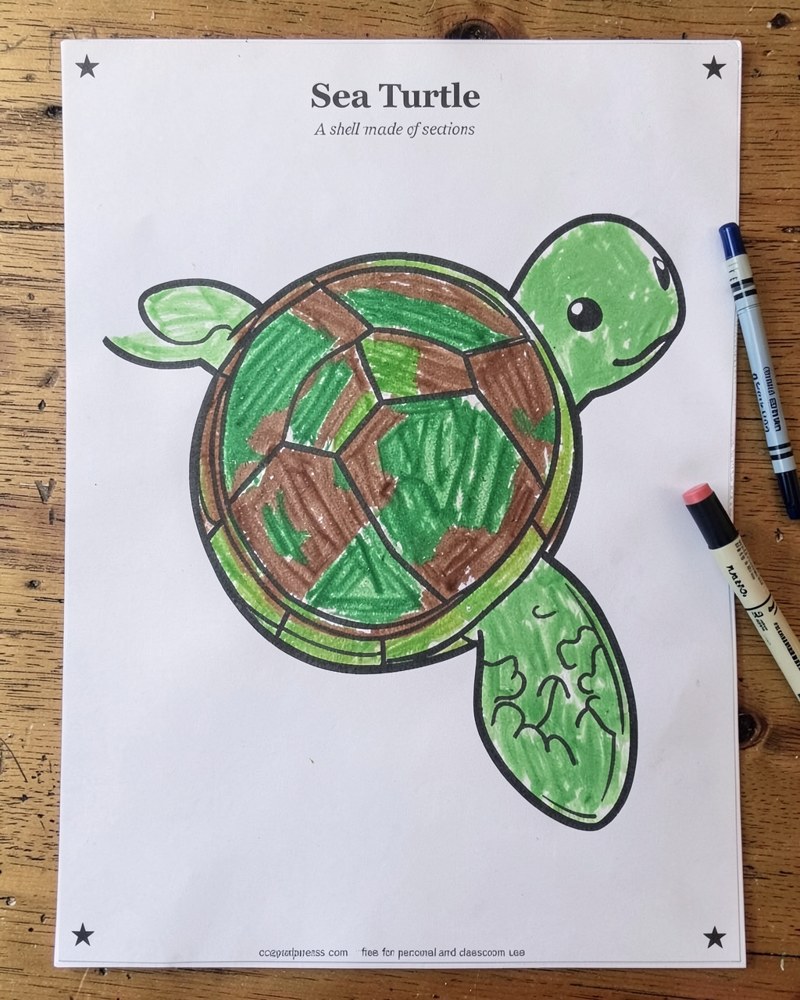

Neither sample is a child's work: we tinted these pages digitally to show two possible color schemes.
To fill in the water, use a wax resist. Color the animal firmly in crayon, then wash diluted blue watercolor across the entire sheet. Paint beads up on the crayon and soaks into the bare paper, so the animal stays bright while the ocean appears around it.
04 —Make an Ocean Wall Mural
This is the project the set was built for. It works at home on a door or in a classroom on a bulletin board.
- Color all eight pages. In a class, give each child one animal.
- Cut out the animals along the outer line. Young children can cut a rough shape with a border of white around it, which is easier and looks fine.
- Make the sea. Tape two or three sheets of blue paper or poster board together. Add a strip of tan paper along the bottom for the sand.
- Place the animals by where they live. The crab and its starfish go on the sand. The clownfish, seahorse and octopus stay low, near the bottom and the reef. The turtle and shark swim in the open water. The dolphin and whale go near the top, where they come up to breathe.
- Glue them down and add details: paper bubbles, strips of green paper for seaweed, a wavy white line for the surface.
The placement step is where the learning happens. Ask why the whale and dolphin belong near the surface, and the answer comes straight from the facts list: they breathe air.
With younger children, an adult can do the cutting around the curly octopus arms and the anemone, and the child can cut the simpler shapes like the whale and the shark. Use blunt-tip scissors.
05 —Learning Tie-Ins
- Mammal, fish or something else? Sort the eight pages into three piles. Mammals: whale, dolphin. Fish: clownfish, seahorse, shark. Something else: sea turtle (a reptile), octopus (a mollusk, like a snail) and crab (a crustacean, like a lobster). Our animal classification sorting activity takes the same idea further.
- Air breathers. Ask which animals have to visit the surface. Whale, dolphin and sea turtle all do.
- Counting. Count the crab's legs and claws, the turtle's shell sections or the shark's bubbles.
- Writing. Older children can write one fact under each animal on the mural.
06 —Supplies for the Reef
Pages are laid out for US Letter; A4 users can scale them down a few percent without losing any of the drawing. Pencils and crayons are happy on everyday printer paper. Choose heavier stock for the wax-resist painting, for animals that will be cut out, and for anything that will hang on the mural for weeks.

Small sea animal figures give children something real-looking to hold next to the page while they color and sort. The watercolors are for the crayon resist sea, and washable markers make bold outlines on the mural.
07 —More Sea Creatures to Add
Full-color sea creatures can fill gaps in the mural or serve as a color reference. These three sets belong to our sea animals and ocean clipart shelf, each drawn by an independent designer.
If the child wants clean outlines to trace or cut, these sea animal silhouettes are a good next step.
The penguin in our bird coloring pages is a strong swimmer and fits right into the ocean mural. For a change of scene, try the butterfly coloring pages or the dinosaur coloring pages.