Learning
Animal Trivia for Kids: 36 Questions and the Science Behind Them
Animal trivia for kids on three printable pages and an answer key: 36 questions on baby names, animal groups, record holders and how bodies work, with the why.
Our sheets are free. The clipart shown alongside them is sold on Creative Fabrica; those links are affiliate links; a sale may pay the gallery a commission.

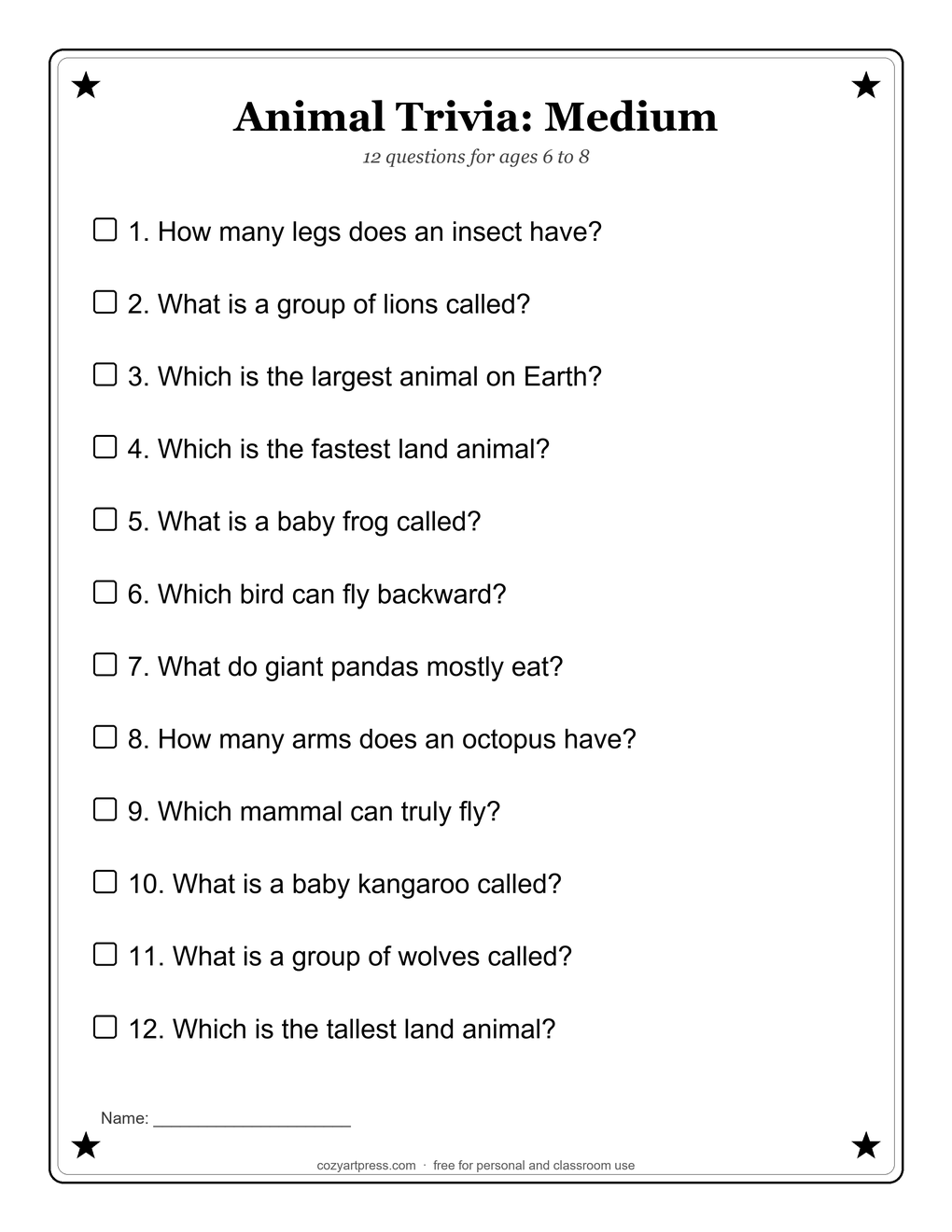
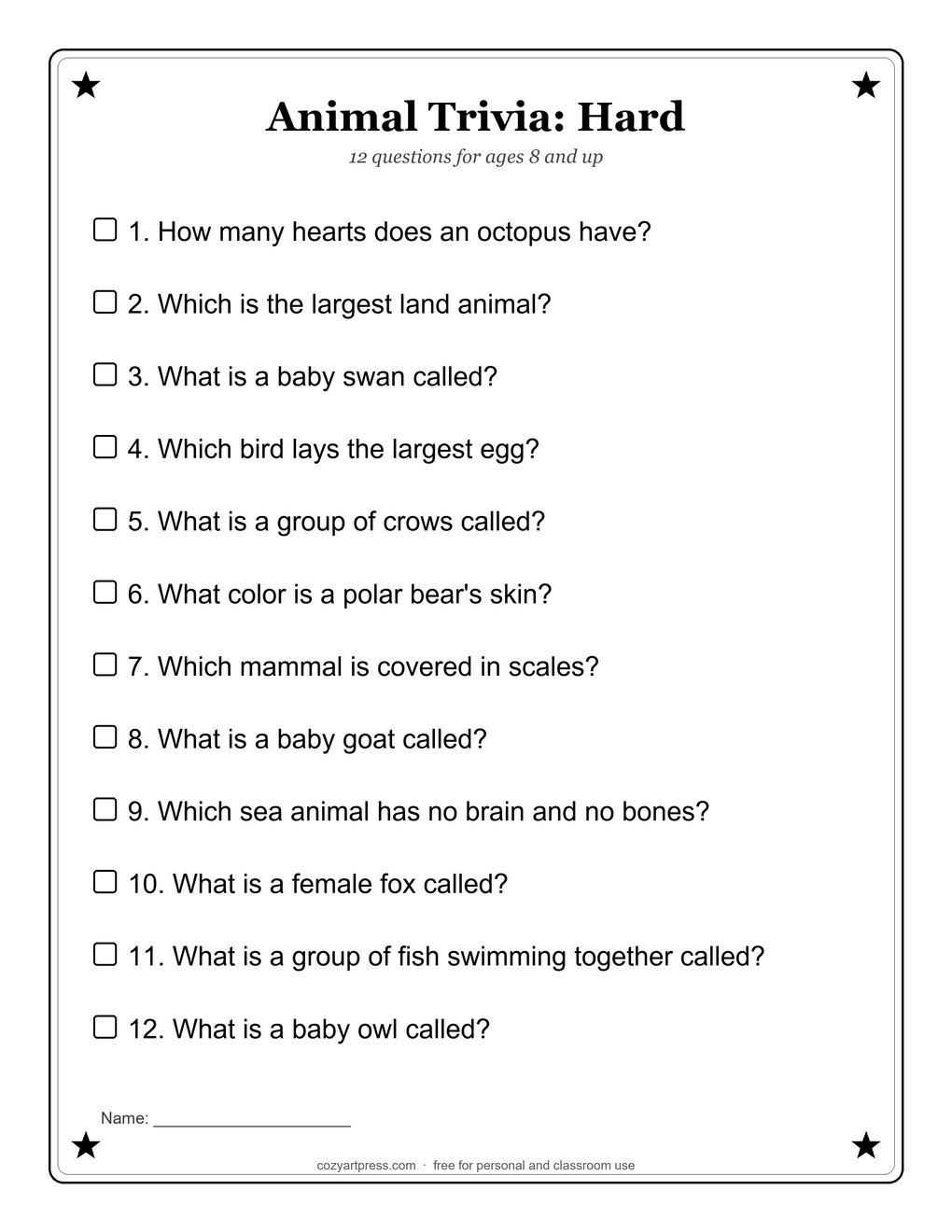
This animal trivia set asks 36 questions over three pages, from "Which animal says moo?" to "What color is a polar bear's skin?", and a fourth page holds every answer. The easy page is written for ages 4 to 6, the medium page for 6 to 8, and the hard page for 8 and up. Each page has 12 questions, each with a box to tick once it has been asked.
Every page is its own PDF, and one file contains all four. They print in black ink on letter-size paper and can be copied for a family or a class.
Free PDF · 4 pages · US Letter
The sheets
Click a sheet to open its PDF. Print at 100% scale (or fit to page on A4).
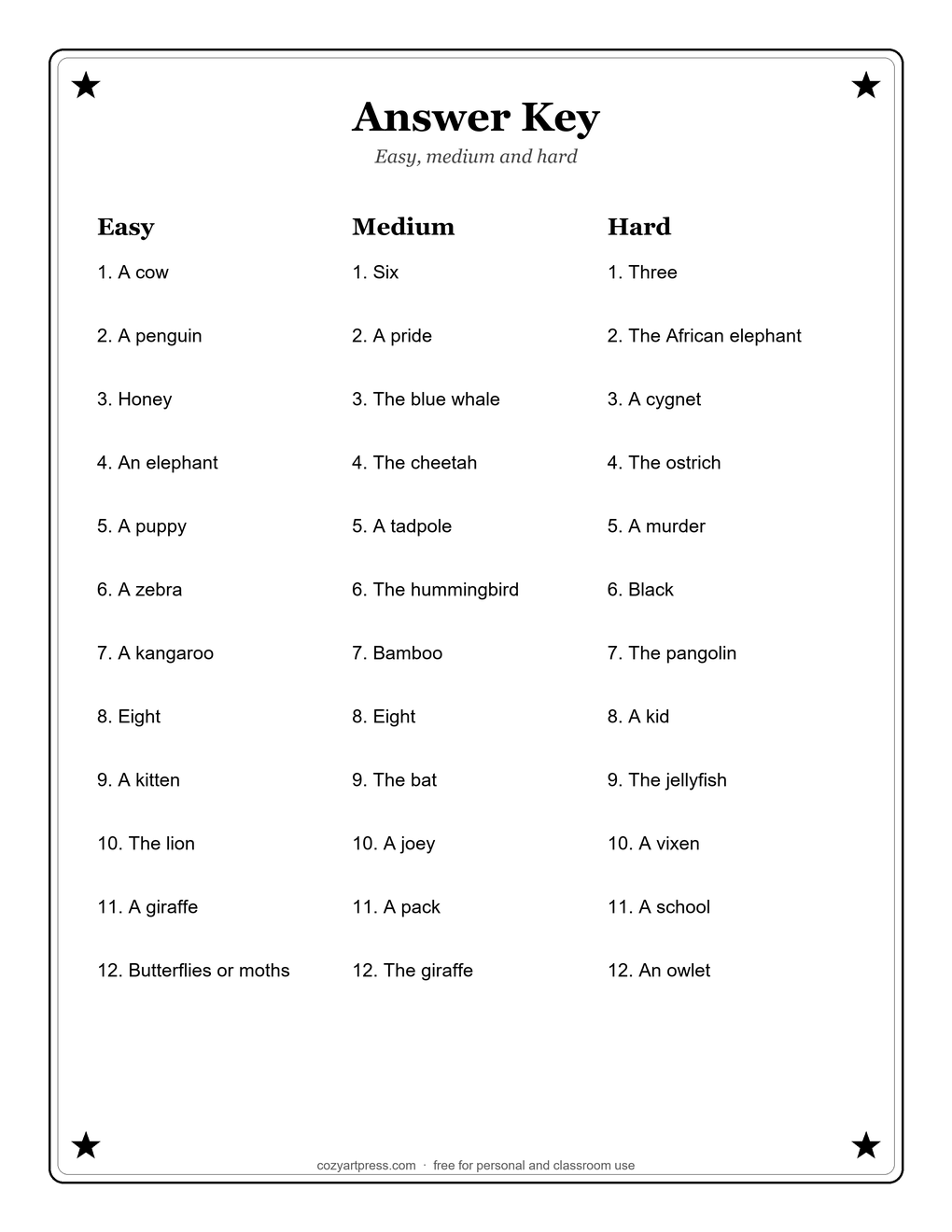
Download the whole set as one PDF — 4-page PDF: 36 questions, key included.
01 —What the Questions Cover
Read across all three levels and the 36 questions fall into three topics. Knowing them helps you pick questions for a lesson rather than reading straight down a page.
| Topic | How many | Examples from the set |
|---|---|---|
| Names for babies, groups and females | 12 | puppy, tadpole, joey, cygnet, owlet; a pride, a pack, a school; a vixen |
| Record holders | 5 | largest animal, fastest and tallest land animals, largest land animal, biggest egg |
| Bodies and habits | 19 | a spider's legs, a pouch, bamboo, an octopus's hearts, scales on a mammal |
The names topic is pure vocabulary, and children enjoy it most. A cygnet, a kid and a vixen tend to stump even adults.
02 —Picking a Page for a Child
The ages on each page are a starting point. A five-year-old who reads animal books every night may clear the medium page, and many grown-ups miss two or three on the hard one. If a child misses more than half, drop a level; if they get everything, move up without waiting.
The pages also echo each other on purpose. The easy page asks how many legs a spider has (eight), and the medium page asks the same about an insect (six). Put those two side by side and you have a short lesson on why a spider is not an insect.
03 —Why the Hard Answers Are True
A naturalist does not stop at the answer. Here is the reasoning behind five from the hard page, so you can explain them when a child asks "really?"
- A polar bear's skin is black. The fur over it has no pigment; each hair is clear and only looks white as it scatters light.
- The pangolin wears scales. It is the only mammal covered in them, and they are made of keratin, the same material as your fingernails.
- An octopus has three hearts. Two push blood through the gills, and the third sends it around the body.
- A jellyfish has no brain and no bones. A loose web of nerves spread through its body lets it sense its surroundings and swim.
- The ostrich lays the largest egg of any living bird. One egg holds roughly as much as 20 to 25 chicken eggs.
The "murder of crows" answer has a story too. Fanciful group names like it were collected in English lists in the 1400s, and many of them stuck.
04 —Hosting the Quiz
The pages can be read straight through, but a simple format turns them into a game.
- Quizmaster. One reader, everyone else calls out answers, one point for the first correct one. With mixed ages, give the youngest a few seconds' head start.
- Two teams. Teams alternate; a missed question passes to the other side.
- Circle turns. Each player gets their own question, so a quick older sibling cannot answer for everyone.
- Ladder. All players start on the easy page. A right answer moves you up a level, a wrong one moves you down. Three correct hard answers wins.
Thirty seconds per question is plenty. With small children, skip the scorekeeping and just enjoy the surprises.
05 —Trivia in a Science Lesson
- Pre-test. Before a unit on mammals or insects, read the questions on that topic and see what the class already knows.
- Daily three. Three questions each morning; one page lasts a school week. The tick boxes keep track.
- Library hunt. Give pairs the hard page and a stack of animal books. They find each answer before the key comes out.
- Exit question. One question per child on the way out the door.
The learning goal for the whole set is simple: children should be able to say not only what the answer is, but how they could check it.
06 —Following an Answer Further
Any answer can open a longer conversation. Take "Which is the largest animal on Earth?" The blue whale, and then:
- How long is it? Up to about 110 feet. Pace that out on a sidewalk or a hallway.
- Is it a fish? No, it is a mammal that breathes air through blowholes.
- What does something that big eat? Find out together.
- Where does it live? Find its oceans on a map.
- Is it the largest animal that ever lived, bigger than any dinosaur? Look it up.
One question handled this way fills ten minutes of a long drive.
07 —Fact-Checking Their Own Questions
When the 36 run out, children can write the next set. Ask each to write three questions about an animal they know well, with the answers on the back, and to name where they checked each fact: a library book, a zoo sign, a nature program.
That last step is the naturalist's habit. Writing a fair question means checking the fact and wording it so someone else could know it. Pets make easy first subjects: "How many toes does our cat have on a front paw?" Most cats have five.
08 —Supplies, Pictures and Prizes
Copy paper is fine for one game. For a set you will reuse, print on heavier paper and keep the answer key in its own envelope so nobody peeks. A small reward adds excitement at a party; stickers and tiny animal figures both fit the theme.
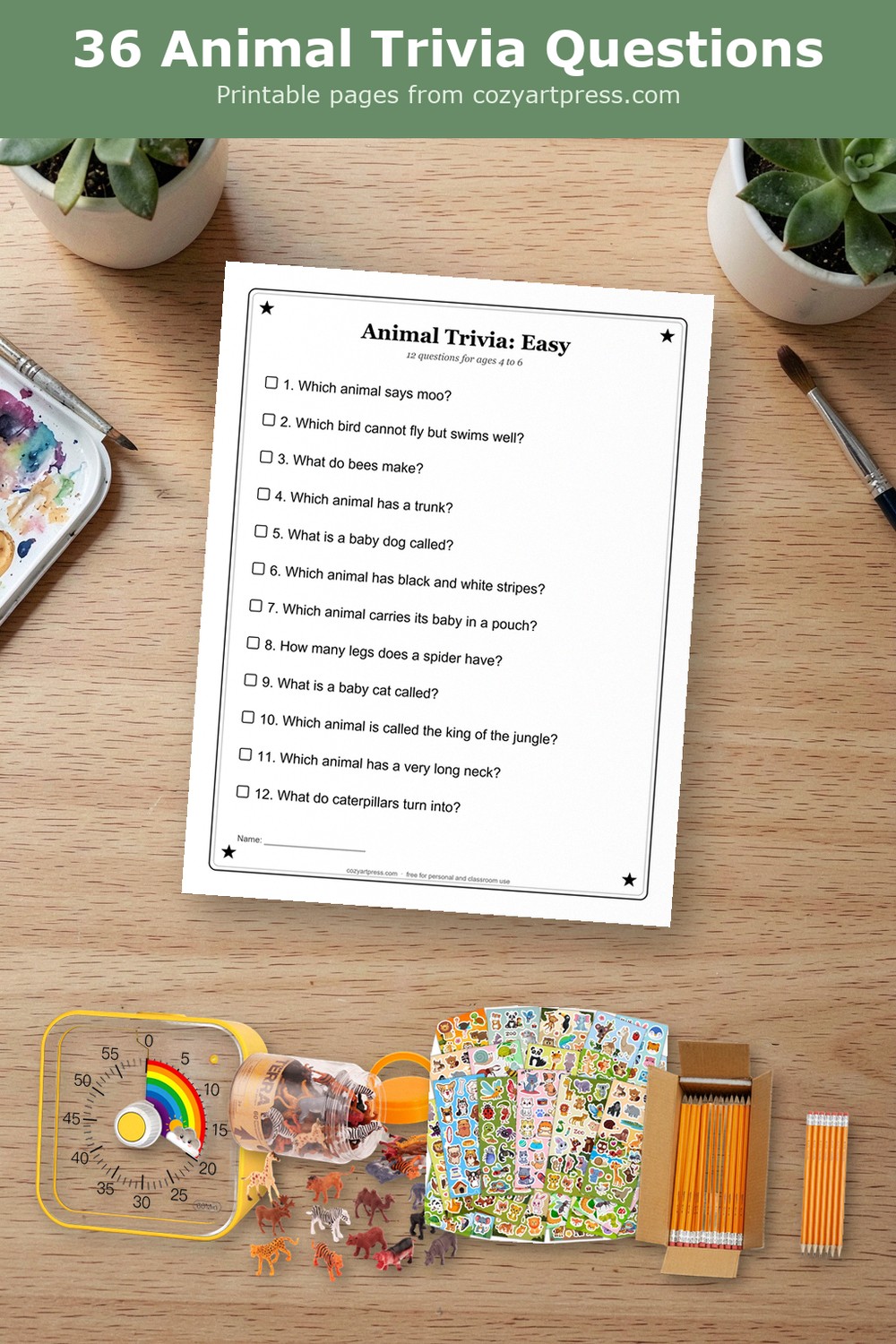
For younger players, a picture helps the answer stick. Hold up an image of the animal right after the answer is read. The three sets below come from our safari and jungle animal clipart, which covers the lion, giraffe, zebra and elephant questions.
09 —More Questions to Chase
For riddles that end in "Who am I?", try our animal riddles for kids. The animal charades cards and the animal bingo cards use many of the same creatures, and every free sheet is on the printables page.

